
For a long time, B2B Ads worked with a simple logic: If you optimize campaigns with a lead volume objective, you end up getting a pipeline.
We optimized our campaigns based on the conversions generated by the campaigns, while monitoring the CPL. The low cost of traffic and the precision of targeting allowed us to generate an interesting volume of qualified leads.
In recent years, this mechanism has been out of order. Not because advertising no longer works, but because the rules of the game have evolved: advertising agencies are more and more automated, they explore more widely, and costs are rising. In this context, A bad signal is no longer a small mistake : it has a negative impact on the learning of advertising account campaigns.
In this study, we will understand:
👉 why the regulator can remain “reassuring” when the pipeline is already beginning to deteriorate.
👉 this has changed over time, with agencies expanding their targeting and CPCs increasing naturally.
👉 how campaigns optimized solely on on-site conversions can automatically lead to low-qualified leads, which do not transform into opportunities.
👉 and what happens when you connect the management system to the CRM and pilot on qualification signals, figures supporting four cases.
A few guidelines to avoid misunderstandings:
📍 Raw lead: contact who filled out a form.
📍 Qualified lead: ICP contact validated in the CRM.
📍 Cost per qualified lead: marketing cost/qualified leads.
📍 CPO: marketing cost/opportunities.
The study in summary
- B2B Ads campaigns optimized for raw leads generate more and more unqualified leads
- The automation of control rooms (Google, Meta) amplifies this phenomenon
- CPC increased from +15% to +40% in B2B between 2020 and 2024
- Management through CRM conversions (MQL, SQL, opportunities) systematically improves quality
- In 4 cases analyzed, the qualification rate increased to +109%
- The cost per qualified lead falls or remains stable despite inflation
Why can CPL stay good while the pipeline is deteriorating?
Your CPL is good, your business is not.
On an Ads account, the lag often appears in a very concrete way.
On the management side, the platform indicators seem to be clean. The account generates leads, the CPL stays in the target zone, and the volume gives the impression that the machine is under control. At this point, Google or Meta may even give the impression that everything is fine, because the cost per lead is still acceptable.
Then we look at what happens after lead generation.
And now, the subject becomes business. A significant portion of leads do not correspond to the ICP, many do not have the right level of maturity, and some contacts die out even before the first useful exchange. Sales spend time sorting, relaunching, qualifying, and the team is saturated by a volume that does not change.
👉 The first impact is a loss of income. Fewer opportunities, fewer deals, so a pipe that is empty in the medium term.
👉 The second impact, more subtle, is the real CAC, which explodes without being detected on the control side. CPL can remain stable, but the cost per opportunity is rising, and the cost per end customer is following the same trajectory. It feels like we're driving at the right level, when we've simply moved the problem further down the funnel.
In these moments, the first instinct is often to look for a cause in terms of execution. We are reworking the promise, we are simplifying the form, we are redoing the landing, we are tightening the targeting, we are adjusting the ads.
Sometimes it's necessary, but there's a deeper factor. The control room optimizes exactly on the objective you give it. And in many B2B accounts, this goal is still too high up in the funnel. Over time, signals become less accurate, especially with the arrival of formats with wider distribution such as Performance Max. And as the volume of traffic decreases with a constant budget, we generate fewer qualified conversions. The agency does exactly what it is asked to do: generate forms, not revenue.
If the main conversion is a submitted form, the platform learns how to generate forms. It then favors the segments that fill the most easily. It does its job. The problem is that this objective does not automatically produce qualified leads or opportunities.
As long as the agency is rewarded for a raw lead, it becomes very efficient at producing raw leads. The quality of opportunities does not automatically improve.
Part 1 - The context: the agency has evolved towards wider targeting, and the market is more expensive
1) Automation: the more the platform decides, the more the precision in terms of the conversion objective weighs
The first change is the rise of automation. With mechanisms like Smart Bidding, the advertising agency relies more on algorithmic data than before, leaving advertisers less control. It arbitrates a large part of the parameters that were historically controlled: auctions, requests, audiences, devices, schedules, combinations of textual and creative content.
Above all, she is a fast learner. This means that the quality of the system depends directly on the quality of the objective that is given to it.
The second tipping point is the opening of the playing field. Between keywords that go towards more broad and new campaigns like PMax where precise keyword control is limited, exploration is becoming broader.
Very concrete result : the platform succeeds in looking for more leads than before thanks to its advances, but these leads are not always qualified, and it can naturally drift into areas that convert easily but are of little use in B2B: very informational queries, curious profiles, curious profiles, small structures, non-fundable leads.
Why is CPL no longer a good indicator in 2026?
2) CPC inflation: less volume for an identical budget
Second element: costs are rising. Between 2020 and 2024, there is an average increase in CPC Search B2B between +15% and +40%.
And the average CPC levels in France by vertical are already high:
👉 SaaS/Tech: €3 to €8
👉 Finance/Professional insurance: 6€ to 15€
👉 IT/Cybersecurity: €8 to €20
Why this pressure? Because truly intentional requests in B2B are rare and coveted, because auction automation naturally pushes the market up as soon as a segment is profitable, and because global advertising inflation spares no one.
👀 The consequence is simple: the more expensive the click is, the less clicks you can buy on a given budget. You therefore have less traffic, and mechanically it is more difficult to produce a volume of conversions. We can no longer afford to do unskilled trafficking.
Part 2 - The core of the problem: the objective of generating raw lead leads to... raw lead
1) What the algorithm understands (and what it can't guess)
When you optimize a campaign on a form sent, you are giving the agency a very clear objective. Generate as many forms as possible at the lowest cost.
The problem is not this objective. The problem is that in a B2B context, A form says almost nothing about the real quality of the contact.
By default, the platform does not know how to distinguish a contact that corresponds to your ICP from an off-target contact. She also does not know if the person is really in the buying phase or simply in the research phase, or if the company has the right level of solvency or a financeable project. More generally, she does not always understand the difference between a business intention and a general public intention.
So it optimizes with what it measures easily. The probability of a human filling out a form.
👉 And that's where the bias comes in. The more you reward the volume of forms, the more efficient the agency becomes at producing forms. The volume may increase, but the share of usable contacts may decrease, and the pipeline will end up feeling the effects.
Optimizing your B2B Ads only on the raw lead is like training the algorithm on an incomplete signal.
2) The switch: raise a signal that looks like a pipe
Change occurs when management is no longer optimized on a simple form, but on an event that reflects a real commercial advance. Typically, a qualification status like MQL, SAL, or SQL, or a signal related to an opportunity created and monitored.
At that point, the concept of success changes. The platform is no longer encouraged to generate the simplest conversion, it is encouraged to Generate the one that is valuable for your pipe.
🕐 Over time, learning starts to change. The algorithm starts to Encourage what, in your data, is associated with real opportunities, and not just completed forms. It's not immediate, because a more demanding signal requires more learning. But the logic is sound. You stop optimizing for a volume of forms and you direct the management team towards profiles who are really progressing in the sales cycle.
Should you connect your CRM to Google Ads?
Customer case: when the CRM signal disappears, business performance falls out
This mechanism is not theoretical. We see it very quickly as soon as a link breaks between the management and the CRM.
Let's take a simple example: a customer whose performance deteriorated after losing the HubSpot connection and then recovered when the follow-up of qualified leads was restored.
Here is a bit of background:
👉 Q4 2024 and Q1 2025: the CRM connection is in place. The opportunities go back to the management, which makes it possible to optimize on qualified conversions.
👉 Q3 2025: loss of the direct CRM → management connection, following a change of plan. At the same time, the person in charge of qualification in the CRM no longer fills in the fields correctly.
👉 Q4 2025: degradation is becoming visible on business KPIs.
👉 Q1 2026: the follow-up of qualified leads is restored, and the indicators are back in the right direction.
What is striking is the gap between platform reading and CRM reading. The CPL remains fairly stable on the Google side, but the qualification and the cost of acquiring opportunities deteriorate sharply when the signal disappears.
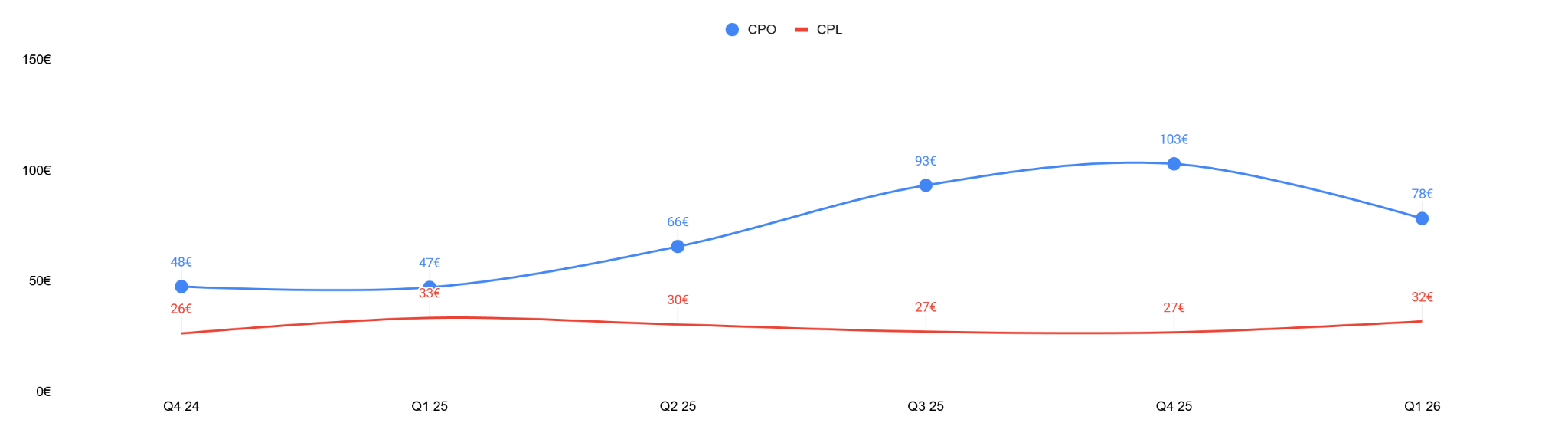
Two readings are superimposed here. The first is the temptation to conclude that everything is fine because the CPL is holding up. The second is business reality: the qualification rate collapses and the CPO explodes as soon as the CRM signal disappears or becomes incomplete.
This is exactly why monitoring by offline conversions is becoming essential. Without this signal, the control room continues to optimize, but it no longer optimizes in the right direction.
Part 3 - The numbers: 4 cases, the same movement
We can discuss theory for a long time but we prefer to show you concretely what happens when you really change the signal and observe the results.
Summary of the 4 cases
Here is a quick read of the 4 cases
👉Case 1 : budget -4%, leads +9%, qualification rate +60%, qualified leads +80%, cost per qualified lead -47%
👉Case 2 : budget -2%, leads -58%, qualification rate +109%, qualified leads -12%, cost per qualified lead +12%
👉Case 3 : budget +9%, leads -11%, qualification rate +24%, qualified leads +10%, cost per qualified lead -1%
👉 Case 4 : budget +10%, stable leads, qualification rate +14%, qualified leads +25%, cost per qualified lead -11%
How can you read these results without making a mistake in the diagnosis?
1 ️ ※ The first visible effect: fewer leads in total
In 3 out of 4 cases, the overall volume of leads falls or stagnates. And that's exactly where a lot of teams stop and conclude too quickly.
👉 Except that this drop is often a sign of something else: the platform stops chasing easy conversions. It's a cleanup, not a collapse.
2 ️ ※ Qualification is progressing everywhere (and sometimes very strongly)
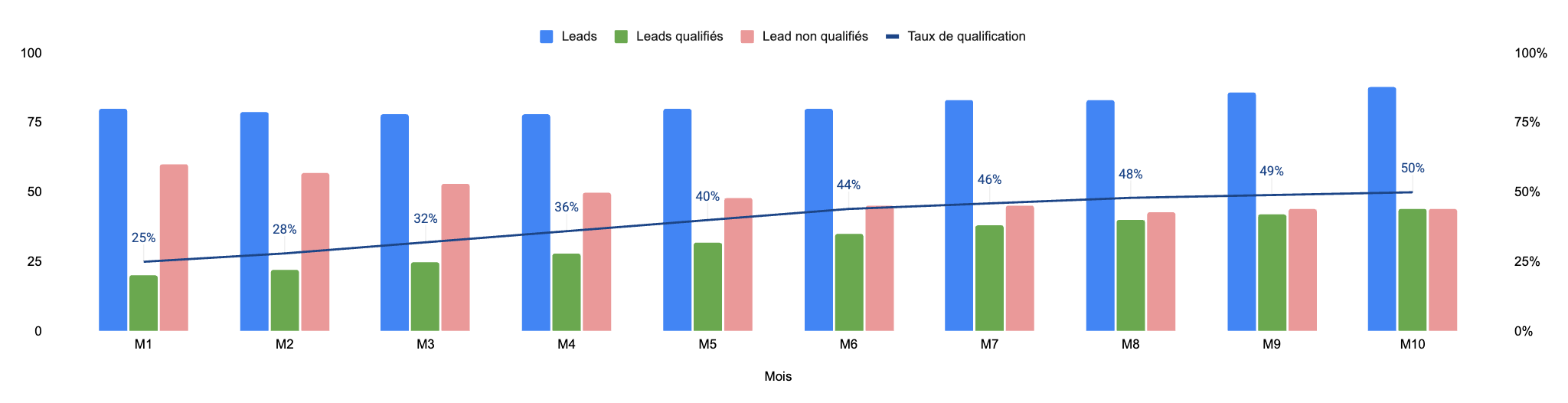
Out of the 4 cases, the qualification rate is increasing. In one case, it went from 21% to 44%, i.e. a relative increase of +109%. In another, 31% to 49%. Even on an account that is already highly qualified (70% to 80%), there is a gain.
👉 The visual below illustrates this dynamic well: on 10 months, the qualification rate Rises gradually (from 25% unto 50%), while the qualified leads increase and that the share of unqualified leads is shrinking.
3 ️ 803 The most telling case: when the volume falls, but the qualified leads stay there
Case 2 clearly shows what happens when you stop optimizing on the form. The volume of leads is falling sharply, but the decline in qualified leads is still limited.
In concrete terms, this means eliminating contacts that would not have advanced in the sales cycle anyway, while maintaining most of the commercial value.
In practice, the desired effect is twofold: less time lost in qualifying on off-target requests, and a more readable pipeline, because the proportion of exploitable leads is increasing. This is often what makes it possible to stabilize low-funnel conversions, even when the total volume of leads becomes less flattering in the control room.
4 ️: The gross CPL lead is becoming a secondary indicator
Look at CPL: case 3 at +23%, case 4 at +10%, case 2 up sharply. Taken alone, it seems like degradation.
👉 Except it's not inconsistent. If you ask the agency to look for more demanding conversions, you agree to pay more for the form. In exchange, you get better quality.
5 ️ ※ The KPI to follow: the cost per qualified lead
This is the indicator that puts everything into perspective, because it directly links Ads to commercial reality:
👉 In all four cases, we observe a generally healthy trajectory.
👉 In two cases, the cost per qualified lead falls significantly, with -47% and -11%.
👉 In a third, it remains almost stable despite a more expensive market, with -1%. And in the most brutal case in terms of volume, where raw leads collapse, the increase remains contained at +12%.
In other words, even when the raw lead CPL becomes less readable, this KPI does not get carried away. It's either improving or it's holding up, which is exactly what we're looking for in a phase where CPCs are rising.
We also see estimates over a period of about 10 months and a direct impact on qualification. The qualified signal requires time to be learned. This change is not judged by a week of results, but by the trajectory that takes shape when the algorithm begins to calibrate itself to real opportunities.
Nuance: raw lead is still useful, but it should no longer guide optimization
The objective is not to remove the raw lead, or to say that it is worthless. In B2B, you often need a certain volume to power the machine, test angles, understand what hooks, and maintain a rhythm.
In other words, the raw lead can remain a secondary management indicator. But the main signal must be closer to commercial reality, otherwise you are taking the risk of an account that seems to be performing well in the interface, while degrading the pipe.
Conclusion: the question to ask yourself in 2026
Control rooms have become automated, exploration is wider, and CPCs are increasing. In this context, optimizing only for raw leads means optimizing on an indicator that does not sufficiently reflect the value created.
The switch is not a recipe, nor is it a permanent account overhaul. It is a fundamental adjustment. You stop asking the Régie to produce as many forms as possible, and you teach them to recognize what looks like an opportunity.
🎯 The initial question is simple: does the conversion event used by the algorithm really resemble your future customers?
❌ If the answer is no, the platform will do its job, but it will improve in a direction that is of little use to you. The risk is a real CAC that drifts without being visible in the control room, a pipe that is filled with leads that are difficult to convert, and a sales team saturated by qualification. In the medium term, it's lost income, because useful opportunities are becoming a minority.
✅ If the answer is yes, you are much more likely to stabilize performance despite inflation, and to improve what really matters: qualifications, opportunities, and then income. You finally pilot on signals that protect the margin, improve the cost per opportunity, and make the pipeline more predictable. And this is usually where the sales marketing alignment comes back, because the volumes are less “flattering”, but the deals are more concrete.
What to do concretely
- Connect the CRM to the network (Google Ads/Meta)
- Report qualified conversions (MQL, SQL, opportunities)
- Accept a drop in lead volume
- Manage the cost per qualified lead and not the CPL
- Analyze performance over several weeks (learning time)
background
1. Structural change in management
In recent years, agencies like Google have changed towards more automation.
A- Generalization of Smart Bidding
Manual strategies have become marginal in management
The algorithm decides:
- Auctions
- Queries
- Hearings
- Devices
- Schedules
- Creative combinations
The performance therefore depends entirely on the conversion signal sent.
B- Massive expansion of requests
With:
- Default Broad Match
- “Smart” broad correspondence (AI max)
- PMax with little control over keywords
- Exploratory audience signals
Google is greatly expanding the scope of exploration.
Consequence: traffic is becoming more voluminous, more hybrid, higher funnel.
Without accounting, the algorithm can promote:
→ Information requests
→ Curious profiles
→ Small structures
→ Non-fundable leads
2. Structural inflation of CPCs
Google Ads — B2B
- WordStream Benchmarks/LocaLiq/B2B SaaS Agencies
- Average increase in B2B CPC Search: +15% to +40% between 2020 and 2024
- Average CPCs observed:
- SaaS/Tech: €4 to €12
- Finance/Professional insurance: 8€ to 20€
- IT/Cybersecurity: €10 to €25
Factors identified:
→ Saturation of high-intent queries
The volume of B2B keywords is limited. Everyone is fighting over the same requests for direct ROI.
→ Auction automation
Smart Bidding, tCPA, RoAS:
- The algorithm maximizes the probability of conversion
- If the market can pay more → it pays more
- Auctions are becoming auto-inflationary
→ Global advertising inflation
CPM is up on all platforms → CPC is mechanically following.
Historical management vs qualified lead management
The bias of raw lead management
When Google optimizes to “Lead”:
The algorithm seeks to minimize the cost per conversion.
It does not include all qualifying elements, such as:
- B2C vs B2C queries
- Target customer or not (good business sector)
- Solvency or project maturity
- The probability of closing
Mechanical result:
→ More volume
→ Fewer qualifications
What does the qualified signal change
When we go up:
- MQL
- SAL
- SQL
- Deal
Google no longer optimizes on ease, but on business probability.
The algorithm gradually learns:
- Requests that are really correlated to the closing
- High-performance time segments
- Qualifying devices
Cross-reading of the 4 cases
What the data shows collectively
1. Global lead volume
Common trend observed:
- Lower gross volume in 3 out of 4 cases
- Stability or slight increase only when the account was already structured
Range observed:
- -58% (case 2)
- -11% (case 3)
- Stable/+9% (case 1)
Reading.
Gross volume is becoming a secondary indicator.
The drop corresponds to an algorithmic cleaning, not to a loss of business performance.
2. The qualification rate is increasing systematically
In 4 out of 4 cases, the qualification rate increases.
Estimates over 10 months of what can be obtained (with the cases studied):
We observe a direct impact on the qualification rate of leads, which leads to
3. Volume of qualified leads
Recurring behavior:
- Strong increase when the gross volume remains stable (+80% case 1)
- Stability despite a massive drop in gross volume (case 2)
- Moderate increase in an inflationary context (case 3 +10%)
- Rapid improvement in the qualified proportion (Case 4)
Reading.
Even when traffic falls, business volume remains stable or increases.
4. Volume of “waste” leads
Case 2:
- Raw leads -58%
- Qualified leads -12%
Why it's good:
- Less time lost by salespeople on ineligible prospects
5. CPL (cost per gross lead)
Observed behavior:
- Often on the rise after restructuring (+23% case 3)
- Or stable depending on maturity
Why?
Because Google is no longer looking for easy leads.
The CPL increases at times, but becomes a partial indicator.
6. Cost per qualified lead
That is the key indicator.
Observed results:
- -47% (case 1)
- Stable despite CPC inflation (case 3 -1%)
- +12% only despite volume drop (case 2)
- Rapid quality improvement (Case 4)
Cross-reading.
In all cases, the cost per qualified lead is
→ In sharp decline
→ Or stabilized despite market inflation
Never any significant drift.
Case 5 : example of a customer whose performance has deteriorated following the loss of the Hubspot connection
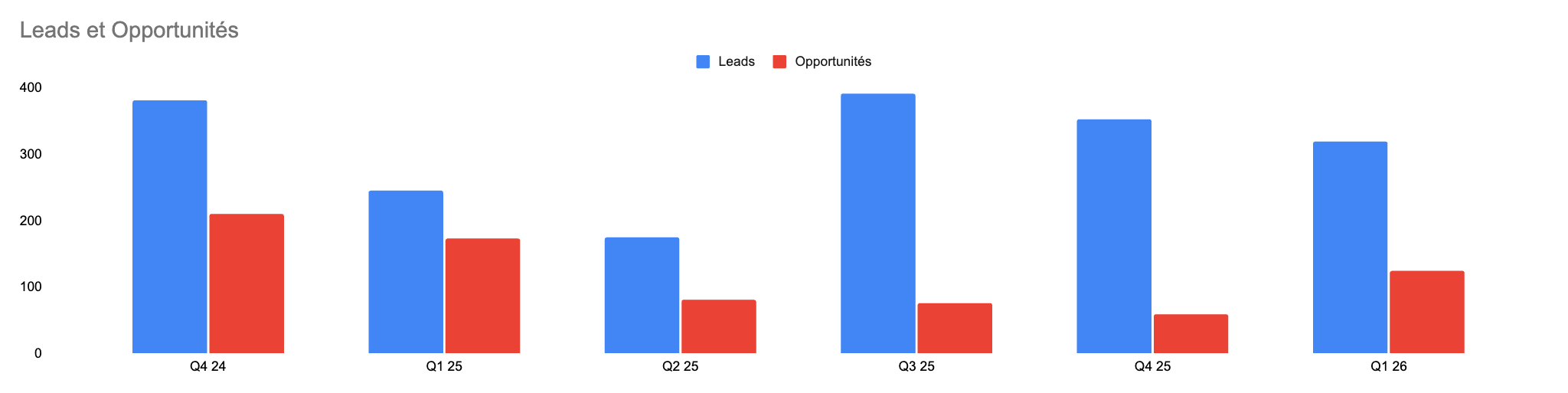
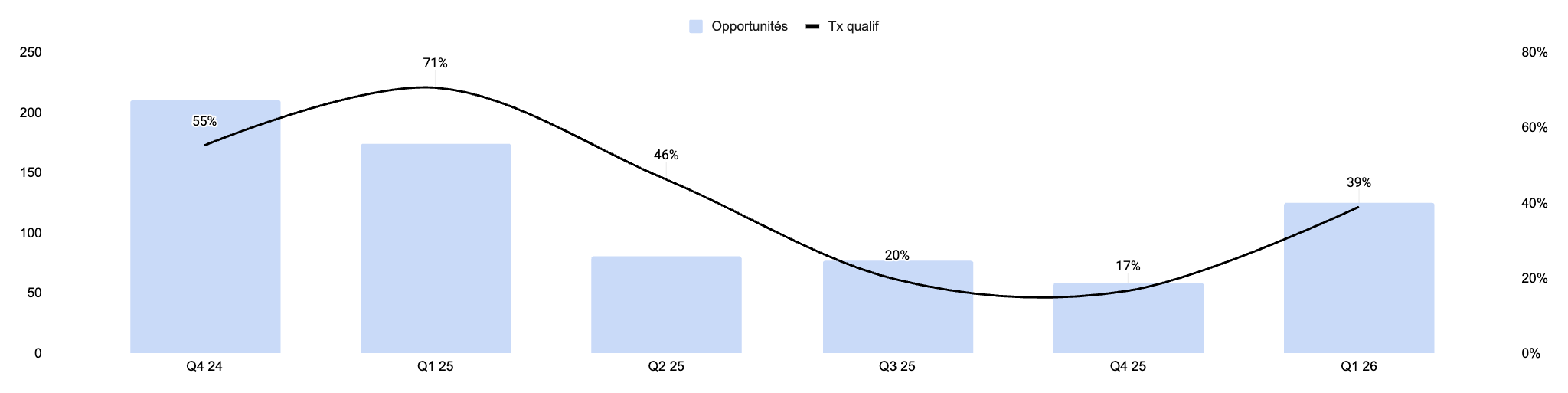
Background:
- Q4 2024 and Q1 2025: Connection with the CRM that allows us to have opportunities that go back to the network and therefore to optimize campaigns for qualified conversions
- Q3 2025: loss of the direct connection between the CRM and the management office (the customer has changed the CRM plan) + the person in charge of completing the qualification on the CRM has stopped completing the elements correctly.
- Q4 2025: performance degradation
- Q1 2026: restoration of the follow-up of qualified leads
