
1. Introduction
Since the arrival of generative AIs, the way in which a business appears online has changed profoundly. We no longer just want to be visible in Google. We want to be cited, taken up or recommended by LLM models: ChatGPT, Perplexity, Claude, Gemini, and all the others.
GEO (Generative Engine Optimization) therefore consists in structuring, documenting and disseminating one's expertise so that the models really integrate it into their responses. The aim is not only to “rank”, but to become a reliable, consistent and relevant source in the eyes of AIs.
Unlike SEO, there are no established rules or consensus yet. But we're starting to see what works, what helps LLMs better understand a business, and what makes them want to cite one over another.
This playbook brings together the principles we apply at Growth Room, to get us and our customers up to date with LLM responses.
Before going any further: 2 important points.
1/ The GEO is a field that is constantly evolving.
What we are sharing here works today, but it was not necessarily true a year ago, and it may not be exactly the case in six months. LLMs change quickly, so do their training methods, and we adapt our techniques continuously.
So think of this playbook as a snapshot of the moment: a summary of what's working for us now, with the tests we conduct every week. In six months, some points may have been refined, corrected or completely revised.
2/ We share part of our method here, but not all of it.
Some techniques are not yet 100% validated, others are more advanced strategies that we reserve for our customers. The aim of this playbook is to give you enough solid foundations to implement.
If you want to go further, deepen certain points or set up a complete GEO strategy, you can of course contact us.
2. Apprehend the LLM
How do LLMs read & select information?
► Understand that the “Google mirror” era is over
At the beginning, appearing in an LLM was almost an extension of classic SEO.
If you were well positioned on Google, or even better, on Bing (the search engine on which ChatGPT relied a lot), you were mechanically more likely to appear in the answers.
Today, that is no longer the case. LLMs still rely on the public web index, but their logic of analysis, interpretation and prioritization has moved away from simple SEO ranking.
Concretely: being good at SEO is no longer enough. You need to adapt the structure and form of your content so that it can be used by a language model.
► Anticipating the arrival of Google AI Overview and the rise of Gemini
Google AI Overview (or AI-Generated Overview) is completely transforming the search interface. Very soon, typing a query will no longer only return a list of links, but a summary generated by the AI.
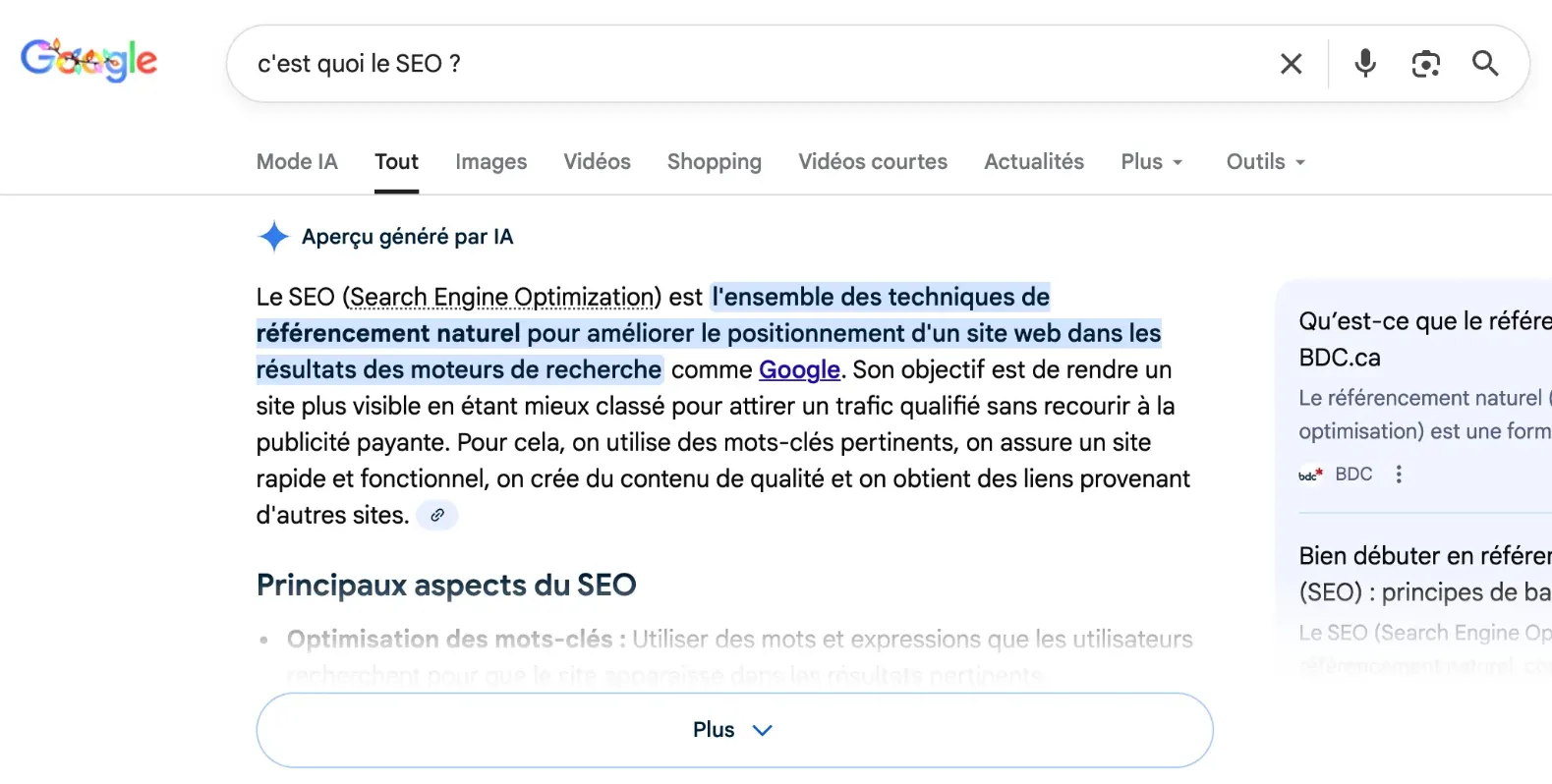
While Google has extended its “AI Overviews” to more than 200 countries and territories, France remains one of the only major markets where the feature is not yet active (due to a legal and regulatory dispute...). Google will no longer only highlight your page, but its own interpretation of your page.
What that means for you:
- It is better to optimize the existing one so that it is fully understood and reused by the models (Google AI Overview, Gemini, but also the other LLMs).
- Clarify, structure, and contextualize each page to maximize automatic comprehension.
- Produce content that “fits” easily into the Overviews: concise answers, well-defined sections, and immediately usable information.
Recommendation : do not create content to create content, but rather optimize it. It's faster, more efficient... and less expensive.
3. Building credibility
How do you become a source that LLMs want to cite?
► Appearing in the media
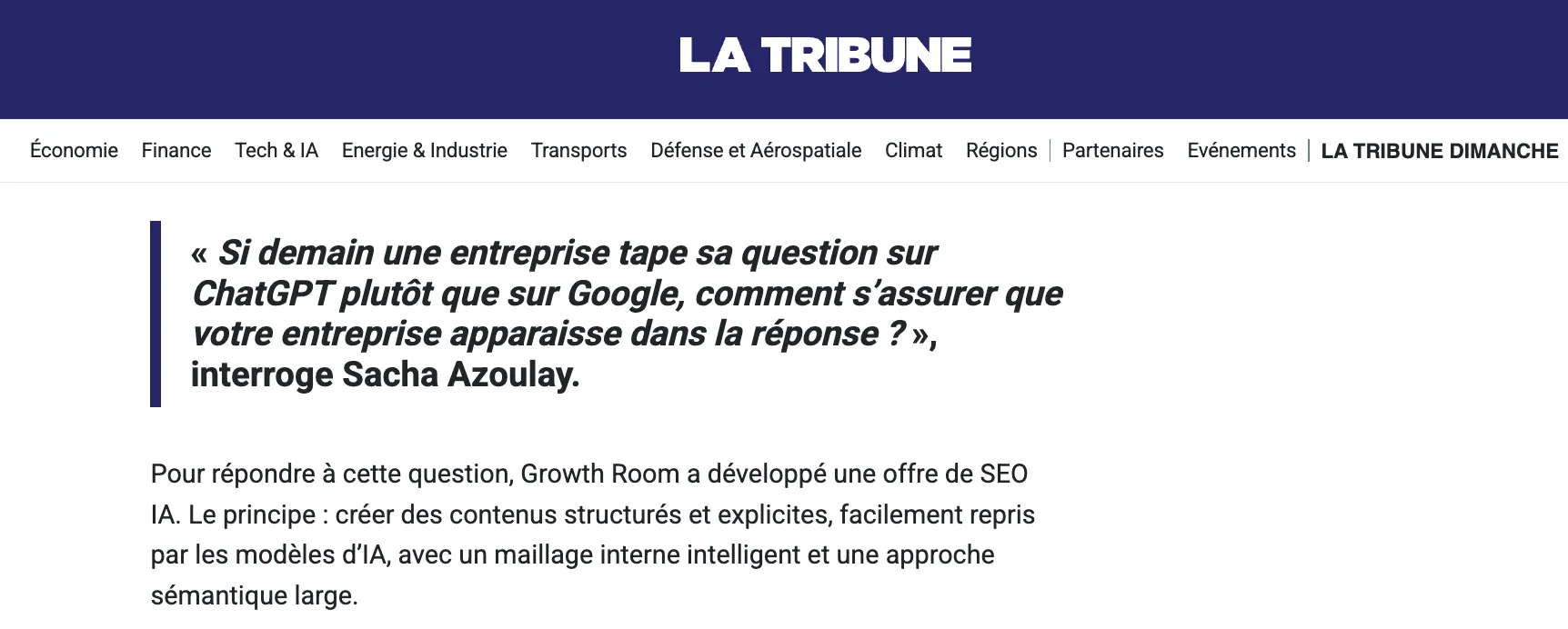
To be cited, you have to be seen as a reliable source. Models need to be able to trust you. Unlike traditional SEO, authority is no longer based solely on backlinks. What really matters is the appearance (not the link). If your brand is mentioned in credible media, even without a link to your site, an LLM will take that into account.
Because the models read the articles themselves, analyze them, and integrate the information directly. Domain authority is still useful, but it is no longer the lifeblood. The important thing is to be present in recognized sources, which AIs consider to be reliable.
For an LLM, a media specialized in your sector will often have more weight than a large generalist media such as Le Monde. Because if you want to be rebuked on a specific subject, models favor legitimate sources in this vertical, those that most clearly demonstrate that you really know your field.
In other words: no need to try to do “pure” netlinking as before. The objective is to be seen by AIs in credible environments.
► Take a stand
When appearing in media, focus on content that provides a point of view rather than a description of your business. LLMs don't reuse phrases like “X is a company that makes Y...” They're looking for insights.
In an article, a sentence like “In real estate, lead generation via Meta Ads works worse than before” will be much more used by LLMs than a corporate description, because it answers a real user question. If someone asks, “How do I generate more leads in real estate?” ”, the LLM will naturally look for sectoral analyses, not fact sheets.
Actionable opinions largely take precedence over declarative ones.
► Becoming a data source
It's really a focal point.
Language models love numbers, measures, comparisons, and benchmarks. You've probably already noticed: as soon as you ask a question related to a study, a market or a performance, LLMs instinctively seek to provide data. The problem is that they don't always have them. And when data is lacking, they improvise, which reduces the quality of their answers.
If you become the one who provides the missing data, then you become a source. And the more reliable, contextualized, actionable data you provide, the more you establish yourself in their landscape as a credible player. Because by providing information that they did not have before, you are enriching their knowledge base. You allow them to be better.
And an LLM doesn't forget it: as soon as they identify you as a useful source, they tend to cite you and push you further. It's a virtuous circle. The more data you introduce into the ecosystem, the more you exist in the responses generated.
This is often more effective than simple general articles: data creates authority.
Example 1: Growth Room
We support a hundred customers simultaneously. We have quantitative and anonymous data on what works and what does not work, by sector, by type of campaigns, etc. We could very well do a study of the evolution of the conversion rate for B2B companies on advertising networks, or of the deliverability rate in emailing. A study based on our data, crossed with the context, the sector and the evolution of the market. This study would be taken up (at least for the figures) by the LLMs.
Example 2: A recruitment company specialized in cybersecurity
She has the salary data of the profiles she places in this field, by seniority, by location, etc. She can therefore quite draw up a salary study. If, in this study, structured data (see part 4 of the playbook) is correctly integrated, it is content that LLMs can use. And above all, it will strengthen your credibility in the sector.
► Becoming the local and sectoral authority
To appear in the answers of LLMs, you must avoid a strategy that is too global. Users almost always ask questions from their own reality: their city, their market, their job. Language models therefore structure their responses in this same prism.
1/ Local level
Localized queries are among the most frequent. If someone is looking for ways to recruit, sell or find a service provider, they will almost always add a geographical context: “in Paris”, “in Lyon”, “in PACA”. The more your content integrates data, examples or trends specific to a city or region, the more you become a relevant source... and therefore reusable.
2/ Sectoral level
LLMs prefer expert sources. To use the example of a company specializing in cybersecurity, publishing a study on cyber salaries or a state of the market by profession creates a very strong signal of authority. This type of content is exactly what models are looking for to answer queries like: “What is the salary of a cybersecurity engineer in Paris in 2025?”
The more your content matches the reality of user requests, the more LLMs will tend to cite you.
Optimize your content
How to test and improve your presence in LLMs?
► Optimize technical readability
When it comes to optimizing your site for LLMs, technique plays a much more important role than in traditional SEO. A search engine like Google can “guess” much of the content of a page even if it is heavy, poorly structured, or hidden behind scripts. An LLM, on the other hand, gives up much more quickly. If they don't understand your page right away, they simply move on to the next source.
Concretely, AI models need your site to be legible, clear and easily interpretable. First of all, on the technical side:
- Your pages should load quickly
- Don't rely on complex JavaScript
- And above all be accessible to LLM robots (the “crawlers”)
If these robots can't show your page, they can't read or cite it.
► Align your content with AI's favorite sources
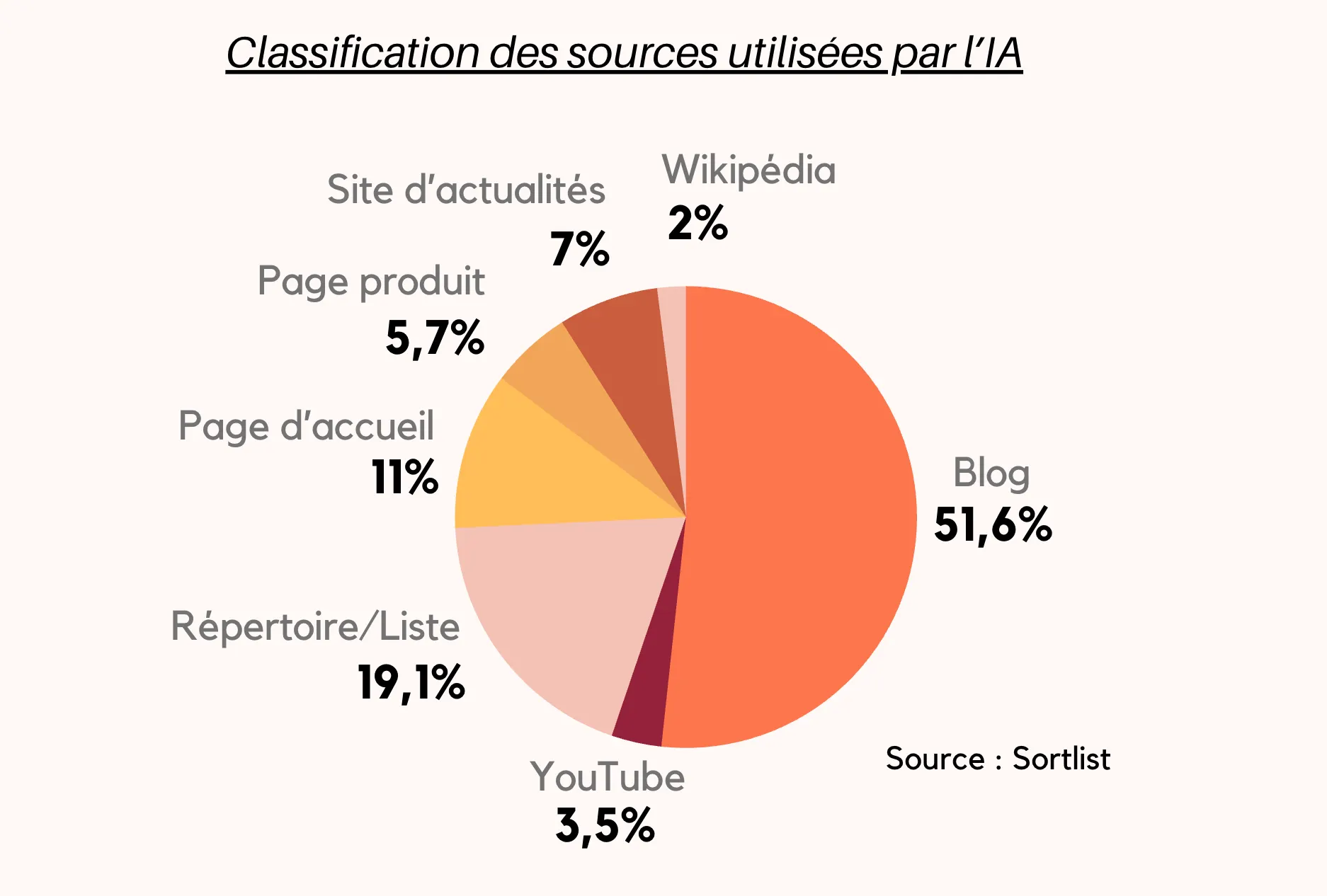
If your brand isn't visibly present in the right blogs or directories, it won't be recommended by the AI. Consider producing content where models will actually look for information: blog posts.
► Structuring your data correctly
But the background is just as important. LLMs need structured data to fully understand what they are reading. Structured data is a way of explicitly explaining to the model: “here is a definition”, “here is a customer opinion”, “here is a service sheet”, etc.
Without this layer of information, your content is not understood.
What should definitely be marked up:
- All pages of the site
- The blog posts
- FAQs (LLMs love it)
- Product or service pages
- Reviews, prices, categories and definitions
A well-structured site is much easier to use for a language model. And the more accurately an LLM understands your content, the more likely you are to be reused in its responses.
► Know how to measure your appearance in LLMs
Measuring your visibility in LLMs is becoming essential.
1/ It's the only way to understand what to optimize
If you don't know what prompts you appear on, or how you are quoted, you are moving forward blindly. Without regular measurement, you can't know if you're on the right track or adjust your strategy.
2/ The models evolve very quickly.
The criteria are changing, the weightings are changing, so are the preferred sources. It is important to be able to anticipate or change them quickly.
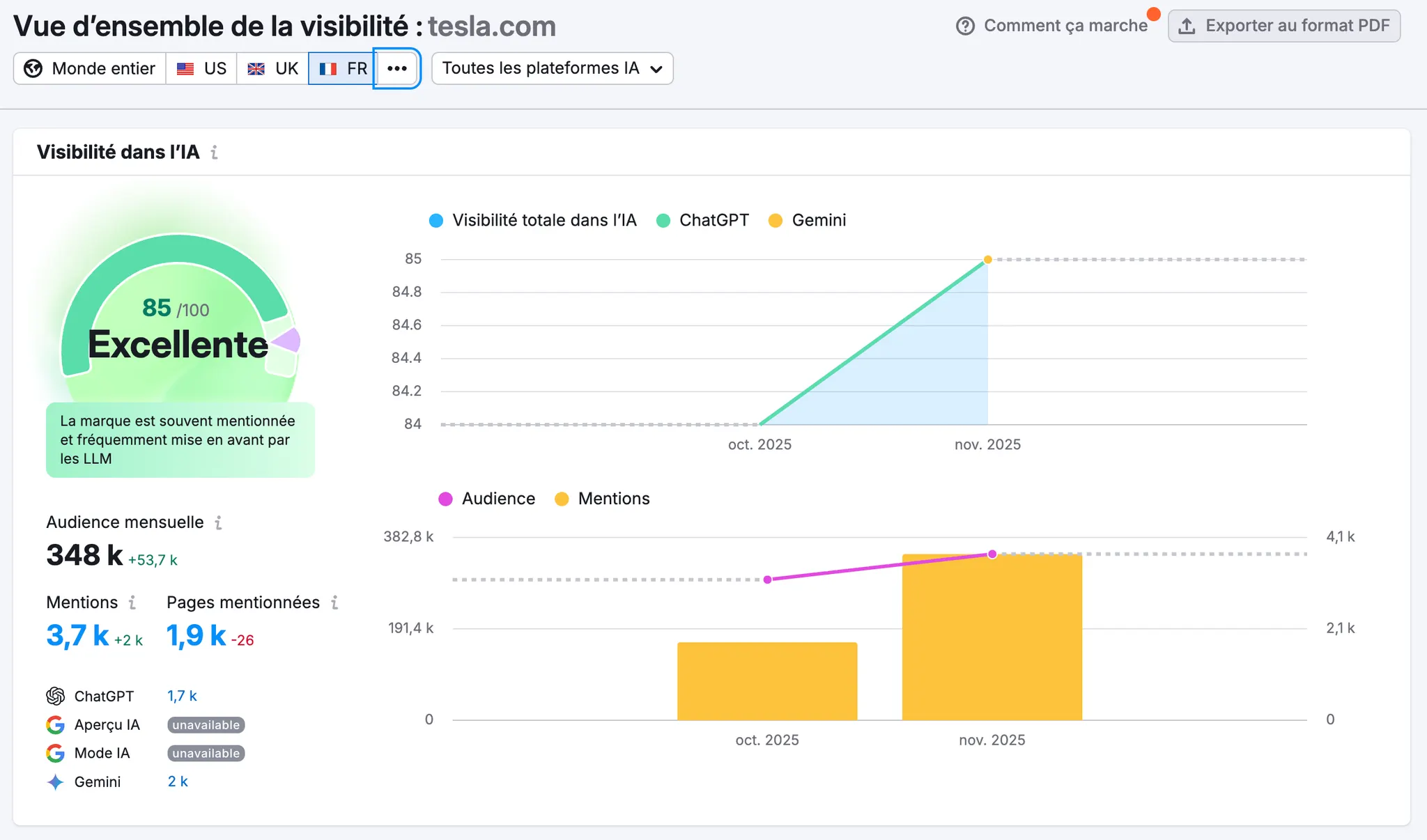
Today, several tools already allow you to have the beginning of a vision:
- Semrush AI (pictured below)
- Omnia
- Promptwatch
They allow you to follow your appearances, those of your competitors, the quality of the quotes and the evolution over time. It's structured enough to give you direction and detect breakdowns after each model update.
► The GEO KPIs to follow regularly
Once you have defined the strategic prompts to appear on, you can follow these KPIs (which have nothing to do with SEO):
- Rate of appearance on strategic prompts
- Feeling associated with responses
- Diversity of sources that cite you
- Evolution of searches related to your brand
- Comparison with competitors
These indicators give you a clear compass: you can immediately see if your visibility is improving, if your positioning is well understood by the models... and especially if your GEO efforts are going in the right direction.
5. Conclusion
Thanks for reading this playbook to the end.
To be honest, we did not expect such a high level of enthusiasm. More than 4,000 people asked to receive it. Initially, we were thinking of doing a short two-minute sheet on Notion... and in the end, we clearly expanded and formatted it.
I would like to take this opportunity to thank the Outbound team, who made it possible to accept thousands of connection requests on LinkedIn, as well as to automatically send the playbook (you won't blame me for not having done it manually...). In parallel with the automated sending (limited to only 20 per day) we made the choice to make it available as a comment on the LinkedIn post.
Again, this is the kind of automation that we put in place for our customers when it comes to digital prospecting.
If you want to go further, on the SEO/GEO part or on the digital/outbound prospecting part, you can obviously contact us.
► Book an appointment with the Growth Room team
We will be happy to talk with you.
