
No more emails. No more LinkedIn invites. No more “cold” contacts. As long as a few answers came in, the model held up. Since 2024, this volume reflex has been getting worse.
The filters have tightened, the mailboxes have filled up and generic approaches no longer work. Volume is no longer an accelerator: It puts pressure on deliverability, weakens sending domains and tires out sales teams who have to manage low-qualified leads.
In this study, supported by market data and the analysis of more than 140 customers, we will understand:
👉 why does the “quanti” model pick up,
👉 how does “quali” convert better with less,
👉 and when the volume remains useful, provided it is controlled to the millimeter.
This new era is based on three key levers:
- the Signal-Based Outbound,
- TheAccount-Based Marketing (ABM),
- the CRM-based Outbound.
We will detail them in the rest of the study, with their logic, their use cases and the results observed.
The end of “spray & pray”
We have all seen this “spray & pray” model at work: a standard sequence, a few customization variables (first name, company name), a more or less cold base, and the hope that the volume will end up producing appointments.
In many dirty teams, the scene is repeated: we start a new sequence on Monday, we follow the stats on Wednesday, we restart on Friday, and we consider that “the pipe is full” as soon as a few appointments fall. Without always looking closely at the quality of the leads, or the impact on the reputation of the sending domains.
👉 On the prospect side, the result is visible : saturated mailboxes, messages that look the same, salespeople who arrive with exactly the same hook as the previous three. The tolerance for this type of approach has dropped significantly.
👉 On the ecosystem side, the signals are just as clear : tighter filters, increased monitoring of complaints, faster blocking of domains that “push too hard.” Mass campaigns are no longer simply less effective: they are becoming risky for the brand and for the teams that run them.
So the question is no longer “how many emails can you send?” , but “how do you design approaches that really deserve the attention of decision-makers?”
Part 1 - The observation: outbound quantum in decline
1. The historical model: the reign of volume
Behind the numbers, there are well-established habits. For years, a sales manager who wanted to “build a pipeline” started with this question: “How many contacts can we push this month?” The debate was about volume, rarely about the level of relevance of approaches.
Historically, “mass” outbound has been based on a simple idea: If enough people are contacted, a small portion will eventually respond.
Before 2024, with tools like Waalaxy or Lemlist, it was possible to send thousands of monthly emails and hundreds of daily Linkedin invitations to “cold” databases without worrying excessively about deliverability.
Even with a response rate of 0.3%, this could be enough to generate about fifteen monthly leads: 7,000 shipments x 0.3% ≈ 21 leads/month.
As long as the mailboxes allowed the majority of messages to pass through, this equation was pretty much true.
The problem is that this equation no longer fits at all in the current context.
2. Why is it working less and less?
a. Deliverability in free fall
Deliverability, that is to say the probability that an email will actually arrive in the main inbox, has become the lifeblood.
According to Validity (2024), the The average inbox placement rate is 86% : it means that 14% of emails do not arrive in the inbox (they are either classified as spam or “lost” in the filters). This figure (86%), combined with an opening rate that rarely exceeds 60%, makes us worried about the gap between the volume of contacts addressed and the volume actually reached.
The Gmail and Yahoo rules applied since February 2024 (and their successive updates) now require:
👉 a verification of the identity of the sender (domain authentication),
👉 a complaint rate of less than 0.3%,
👉 a 1-click unsubscribe link,
👉 and a quick removal of opt-outs (<48 hours).
Microsoft will apply the same requirements to Outlook.com in 2025.
In other words: without technical compliance, even the best sequences end up in spam.
At the same time, on the Linkedin side, the rules of the platform are also tightening to limit daily invitations. Gone are the days of 200 invitations per day.
b. Oversolicited prospects
Decision makers are now receiving an increasing volume of professional emails.
According to a study EmailToolTester (2025), respondents say they receive several “cold” prospecting emails per week, and the campaigns analyzed show response rate generally between 1% and 5%, with strong variations depending on the sector, targeting and level of personalization.
In the same vein, HubSpot identifies similar ranges for unsolicited emails, and emphasizes the key role of targeting and personalization in increasing response rates.
This saturation of the email channel makes personalization essential: without context or relevance, the message goes unnoticed or is directly flagged as spam.
c. The direct impact on conversion rates
Fewer emails delivered = fewer conversions.
MQL or SQL email rate calculations take the number of emails sent as a basis. But this denominator is logically penalized by emails that are not delivered, filtered or blocked.
Result: a mechanical decrease in performance.
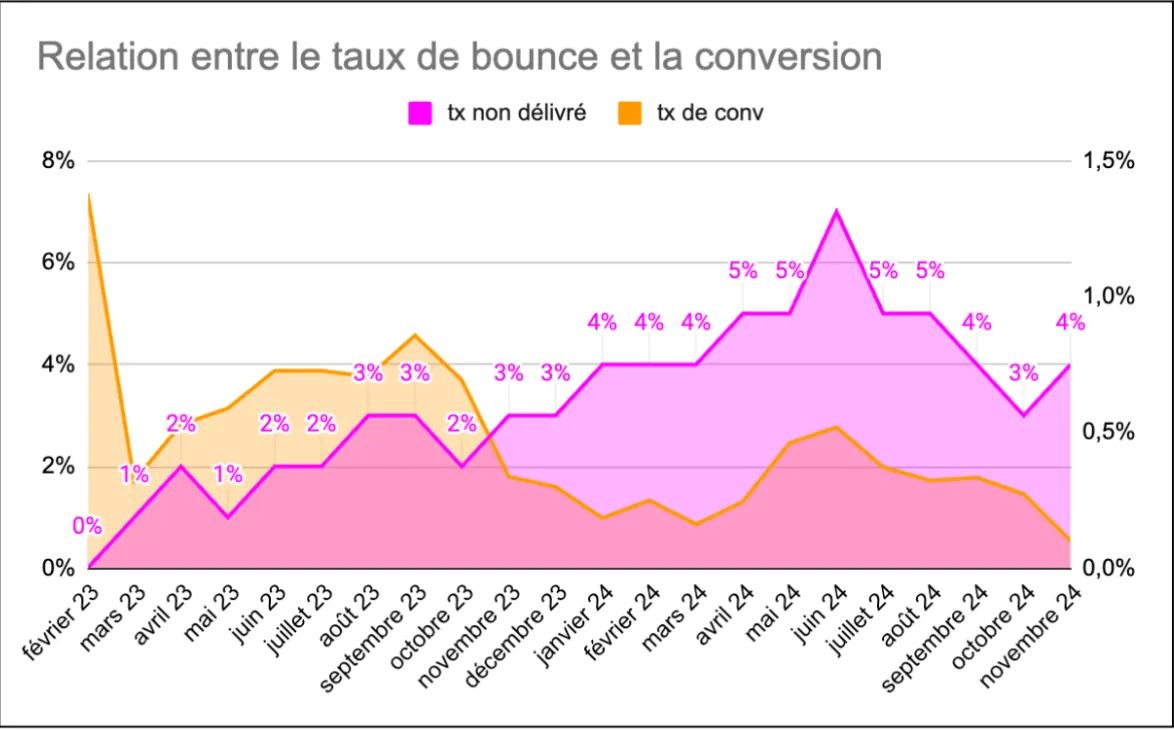
At Growth Room, aggregated mass campaign data on 140 customers shows a 40% drop in performance as of June 2023 And of 63% between S2 2023 and S2 2024 :
.png)
👉 2023:0.7% average conversion rate on mass campaigns
👉 2024:0.5%
👉 1 2025:0.3%
A direct correlation appears between the increase in the bounce rate and the fall in conversions.
Conclusion : the more the volume increases, the more the deliverability decreases, and the more the ROI falls.
The strategy should move from “how much” to “how.”
Part 2 - Towards a qualitative outbound
1. Why switch to quality?
Technical constraints, saturation and the increasing demand of prospects require rethinking the logic of prospecting.
Continuing to “push” volumes in the hope that the filters will let pass and that some leads will eventually fall out is no longer sustainable.
In teams that perform well, we observe another reflex: rather than asking “how much are we sending this week?” , we start with “who do we really need to talk to for this to work, and when to do it?”. The challenge is no longer to “reach” thousands of contacts, but to create relevant conversations with the right decision makers.
Qualitative campaigns focus on the relevance of the message, the timing and the perceived value.
👉 Result : fewer emails sent, but more real opportunities.
2. Qualitative approaches
a. The Signal-Based Outbound
It's the natural evolution of cold emailing: Prospecting in response to a concrete signal.
We no longer target randomly, but at the moment when the need becomes visible.
Examples of trigger signals:
👉 Fundraising announced on LinkedIn or Crunchbase.
👉 Launch of a recruitment campaign.
👉 Participation in a trade show.
👉 Tool change: CRM, marketing automation, CMS, etc.
👉 Publishing or reacting to an engaging post on a key topic.
Thanks to data and AI, these signals are now detectable and usable almost in real time. AI also makes it possible to write highly contextualized messages, while maintaining a consistent tone and sectoral relevance.
🤓 Typical example : a scale-up announces its fundraising on LinkedIn. Rather than sending him a generic sequence three months later, we bounce back in the days that follow with a message that talks about pipeline structuring in a growth phase, specifically quoting their news. Same volume of shipments, but a radically different context on the prospect side.
Average conversion rate depending on the trigger signal
Growth Room internal data - based on +140 signal-based campaigns, 2023-2025
📈 On signal-based campaigns conducted by Growth Room, we systematically observe an interesting phenomenon: the responses are fewer than in bulk... but much more relevant. These are more real discussions, reasoned feedback, and opportunities where the prospect already has an initial interest or an identified need.
In other words: lower volume, but much more useful conversations. Sales people spend time on qualified leads, and that changes everything.
b. Account-Based Marketing (ABM)
ABM is based on collective personalization: we target an account, not an isolated individual.
📍 The objective: address several decision-makers & strategic account prescribers around a common issue.
A strategic or key account can be defined according to its business relevance (average high basket) or its reputation, which will strengthen its credibility (social proof).
Two main formats for ABM:
👉 One-to-one campaigns : a strategic company by campaign, with a tailor-made approach, based on the news/history of the chosen company (for example, a campaign that will target all the final decision-makers of the LVMH group.).
👉 One-to-few campaigns : 15 to 30 accounts sharing the same challenges per campaign, with a “common points” approach.
This approach combines precise targeting, dedicated content and multi-channel orchestration (email, LinkedIn, call, personalized content).
At Growth Room, several ABM tests show SQL conversion rates greater than 4% (RDV/volume addressed), while halving the unsubscribe rates. ROI is also there, with strong growth over time, with addressed accounts generally being chosen for their business relevance (high average basket).
In practice, a good part of ABM work consists in conveying the right signals and adapting the message to each interlocutor. That's where The AI building blocks integrated into ABM tools are becoming useful : they help to go through the history of an account (news, content, public signals) to suggest angles, adapt approaches, and to prepare first versions of messages by persona/pain.
The team obviously keeps control of the substance, but saves time on research and training, which allows more energy to be devoted to strategy and the quality of exchanges.
📈 In terms of performance, ABM rarely generates massive volumes, that's normal. On the other hand, the opportunities created are Significantly more qualified, with higher average baskets and more structuring cycles. On strategic accounts, it is often the campaigns that produce the pipeline the most sturdy and the most durable, even if they are aimed at a small target.
c. CRM-based Outbound
A third lever consists in exploiting the wealth of your CRM.
Who to address? the “dormant leads”! We are talking here:
👉 contacts alone, who live in the CRM (often with little information on their source),
👉 untransformed MQLs (lead magnets),
👉 old opportunities lost for non-discriminatory reasons (timing, budget, change of interlocutor),
👉 companies where exchanges with a contact at the base, finally never succeeded...
At Growth Room, we observe that almost 100% of our customers have large contact bases (non-customers and not processed) in CRM, with as many unexploited potentials. Therefore, you must be able to segment and clean your database to identify opportunities.
How and when to address them? Again, CRM offers a multitude of intent signals to be exploited: website visits, opening a marketing or sales email, opening an old quotation sent, etc. All signals of interest to be used as a trigger for a nurturing sequence, or as a personalization element in email approaches.
A well-managed CRM often makes it possible to Put a significant number of opportunities back in motion, without adding additional acquisition costs.
To exploit this potential, it is not enough to “send more”: you have to a clean, segmented and up to date database. Current CRMs are now on board AI features that give a real helping hand in this game : detection of duplicates, identification of obviously obsolete contacts, suggestions of segments based on past interactions, or even enrichment of certain files with relevant public information. These functionalities combined with a well-thought-out nurturing and reactivation strategy are the secret to successful CRM-based campaigns.
👉 Result: reactivation or nurturing campaigns start on a healthier basis, with messages that better fit the profile and maturity level of each contact.
📈 Regarding this lever, the most striking result is often invisible at first glance: a simple work of segmentation and contextualization makes it possible to reactivate dormant leads at a marginal cost. Where traditional acquisition can be expensive, CRM-based generates “forgotten” but very legitimate opportunities, often with shorter cycles, because the prospect already knows the business.
This is typically the case with these leads who have downloaded a white paper, talked to a sales person once and then disappeared from the radar. Six months later, a simple, well-targeted reactivation sequence, which refers to the initial exchange, is sometimes enough to relaunch a serious discussion, without any additional media budget.
A point of attention on the implementation of this type of CRM-based campaigns: you must choose the right tool (marketing tool, CRM or outreach tool) according to the type of contacts addressed.
Part 3 - Nuances and perspectives
1. Quantitative is not totally dead
Volume strategies remain relevant in certain situations, including:
👉 When the objective CTA is a 'soft' CTA (examples: webinar, free trial), and not a demo or qualification appointment.
👉 When the campaign aims to raise awareness, where the conversions are higher up in the funnel (vs. making an appointment).
At Growth Room, we observe good conversion rates on +30 mass campaigns tested on this type: 2 to 4% SQL conversion, on average.
However, this type of campaign should be supervised, to avoid any risk (especially of deliverability): clean lists (valid emails), complete authentication, complaints < 0.3%, and instant opt-out.
Volume is no longer an end in itself, only an additional lever.
2. The after-volume
Until a few years ago, a well-constructed mass campaign could be enough to fill an agenda: we started a sequence, we pushed the volume up, and with a little patience, the appointments ended up falling.
Between 2023 and H1 2025, Growth Room's aggregated data tells a different story: on mass outbound campaigns, the average conversion rate increased from 0.7% to 0.3%. At the same time, technical constraints have tightened, mailboxes have become saturated and generic approaches have lost impact.
In other words: The Quanti model no longer keeps its promises. It consumes time, puts domains under pressure and feeds a less qualitative pipeline.
The solution is not to “cut everything”, but to Change logic :
- move from a “max. volume” approach to an approach Signal-based, which triggers actions at the right time, on the right accounts;
- focus the effort on strategic accounts via ABM, to create opportunities with a higher average basket;
- finally exploiting the value hidden in the CRM (dormant leads, old opportunities, unprocessed MQLs), rather than addressing only “cold” contacts.
It is this change that Growth Room accompanies on a daily basis:
👉 by combining AI, data and human experience,
👉 by optimizing campaigns throughout the chain, from prospecting to customer signatures,
👉 and by helping more than 140 companies to move away from purely volume logic to build a healthier, more qualified and more profitable pipeline in the long term.
sourcing
- Growth Room — Aggregated Internal Data (140 customers, 2023—2025) : internal source (non-public and anonymized).
- Google — Email sender guidelines (2024) : SPF/DKIM/DMARC, 1-click unsubscribe, spam thresholds / FAQ thresholds < 0.1% recommended/not to exceed 0.3%
- Yahoo — Sender Best Practices (2024) : Best practices & complaint rates / FAQS
- Microsoft — Outlook.com /Microsoft 365: authentication requirements (2025) : DMARC page (Learn) / Email auth overview
- Validity — The State of Email in 2024 : 2024 Deliverability Benchmarks
- Valimail — DMARC 2025 (adoption/enforcement) : 2025 Report
- CNIL — Commercial prospecting by email (France, 2024/May) : CNIL sheet
- Radicati Group — Email Statistics Report 2024—2028 : Announcement & executive summary
- HubSpot — Email Marketing Benchmarks (2024) : Aperture & response benchmarks
- EmailToolTester — Cold Email Statistics & Benchmarks (2025) : Cold email statistics
