Media campaigns
8/10/2026
Why aren't your leads converting into pipeline? Targeting, KPIs, intent: identify the roadblocks and finally generate qualified opportunities.

.svg)

There's a situation many teams observe but struggle to put into words. Campaigns generate leads, volumes are high, costs seem under control... but on the sales side, the pipeline doesn't reflect this effort. Opportunities stagnate, cycles lengthen, and some leads simply go nowhere.
This discrepancy isn't due to an isolated problem or a simple lack of optimization. It reveals a deeper misalignment between what marketing measures and what truly creates business value. Understanding this point is crucial because it dictates the entire performance of the acquisition system.
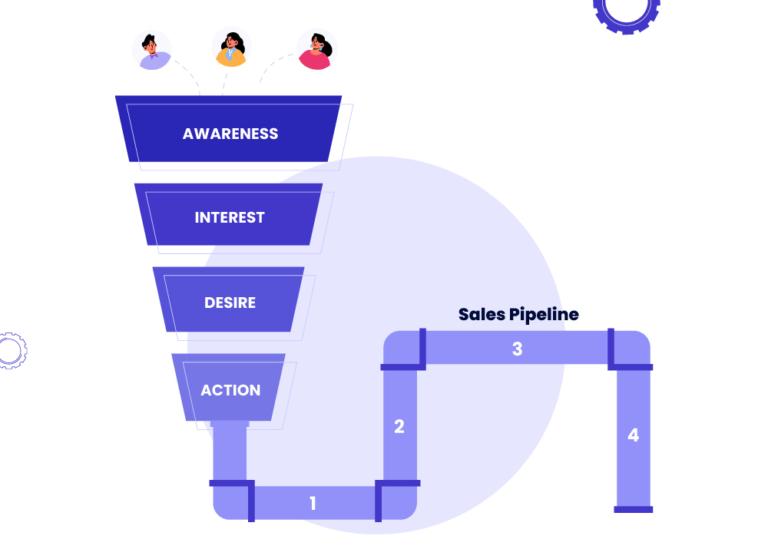
Lead generation has long been perceived as a direct indicator of performance. The more inbound contacts there were, the more effective the system was considered. This logic has been reinforced by digital tools, which now allow for capturing leads at scale, quickly and at a lower cost.
In practice, however, the relationship between a lead and an opportunity has gradually become more distant. Buyers research earlier, compare more, and have multiple interactions before making a decision. A large portion of captured leads are therefore at an earlier stage of the buying cycle.
In other words, you're capturing attention... not necessarily demand.
The term “lead” is often used as a success indicator, when in fact it only represents an entry point into the funnel. Without context, it remains difficult to interpret and even harder to leverage.
For a lead to have real commercial value, it must fit within a specific framework:
Without these elements, the lead remains a weak signal. It might be worth nurturing over time, but it doesn't constitute an immediate opportunity.
Striving to maximize volume inevitably leads to broader targeting. This choice might seem rational in the short term, as it helps fuel campaigns and keep costs attractive.
But it introduces a significant bias: you're reaching profiles who aren't genuinely interested in your offer.
In such cases, the leads generated often exhibit several characteristics:
This mismatch quickly results in unproductive sales interactions and a low conversion rate.

Not all interactions carry the same weight. Yet, they are often treated uniformly in marketing tools.
For example:
Without prioritizing these signals, immature leads are passed to sales, creating a timing mismatch for outreach.
Result: conversations that happen too early, with prospects who aren't ready to commit.
Cost per lead remains a central metric in many organizations. It's simple to track, easy to compare, and gives the impression of performance control. However, it heavily influences decisions.
When optimizing a campaign to reduce CPL, platforms naturally prioritize the easiest profiles to convert, meaning those who fill out a form quickly, without necessarily having strong intent.
This leads to several effects:
The problem isn't immediately visible in marketing dashboards, but it becomes very clear in the pipeline.
This is often an underestimated, yet crucial point. Marketing and sales don't always work with the same definition of a qualified lead. The former focus on contact generation, while the latter focus on the ability to open opportunities.
Without a common framework, several frictions arise:
This lack of alignment prevents optimizing the system as a whole, since each team operates according to its own criteria.
Yet, the CRM holds the answer to a crucial question: which leads actually generate revenue? However, in many companies, this information is rarely used to drive acquisition.
Without a feedback loop:
In other words, you're improving your campaigns without knowing if they're truly contributing to your growth.
Ad platforms don't prioritize quality by default; they aim to optimize the signal you provide them.
If that signal is a lead, they generate leads. If that signal becomes a qualified opportunity, their behavior changes.
This is where the connection between CRM and acquisition becomes strategic. By feeding back data that is closer to revenue, you enable algorithms to learn to identify higher-value profiles. Without this, they remain stuck on superficial signals.
Reverting to an intent-based approach is a crucial first step. Not all leads should be treated the same way, and it becomes essential to understand where they truly are in their journey.
Specifically, this involves segmenting:
This perspective profoundly changes the way we work, as it allows for adjusting both the timing of contact and the nature of the message. A prospect in the exploration phase doesn't expect the same thing as a prospect in the decision phase, and it's often this mismatch that hinders conversion.
Redefining what constitutes a good lead is equally crucial. As long as a lead remains a simple contact acquired via a form, its value is limited. The challenge is to view it as an indicator of conversion probability, rather than an end in itself.
This requires several adjustments:
This approach allows us to move beyond a binary (lead / not a lead) logic and adopt a more nuanced understanding, much closer to business reality.
The connection between the CRM and acquisition channels plays a key, often underestimated, role. Without this feedback loop, campaigns continue to optimize based on incomplete signals, lacking visibility into their real impact.
By re-injecting conversion data into the platforms, you enable investments to be gradually directed towards profiles that genuinely generate pipeline.
The benefits are tangible:
This work requires a technical and organizational effort, but it represents one of the most powerful levers for improving overall performance.
Finally, alignment between marketing and sales remains essential. It's not just about streamlining communication, but about building a shared framework around performance.
Without this alignment, each team optimizes according to its own metrics, which weakens the entire system.
Specifically, this requires:
When this alignment is in place, the perception of leads changes. They are no longer just a volume to process, but a qualified resource directly linked to the pipeline and revenue.
When these different levers are activated, the effects are quickly noticeable. The volume of leads may decrease, but their quality significantly increases. Salespeople spend less time qualifying and more time selling, which improves their overall efficiency.
Typically, we observe:
But above all, a shift in how performance is managed. The lead is no longer an end in itself; it becomes a means to drive revenue.
To delve deeper into these challenges and structure more effective prospecting, read our complete study: playbook outbound B2B !

3 Boulevard de Sebastopol, 75001, Paris
©Copyright 2024. All rights reserved.

If you want to keep in touch, and get a summary of Growth Marketing every week, it's just happening here 👇